


Saturday, February 28, 2026
8:00 PM
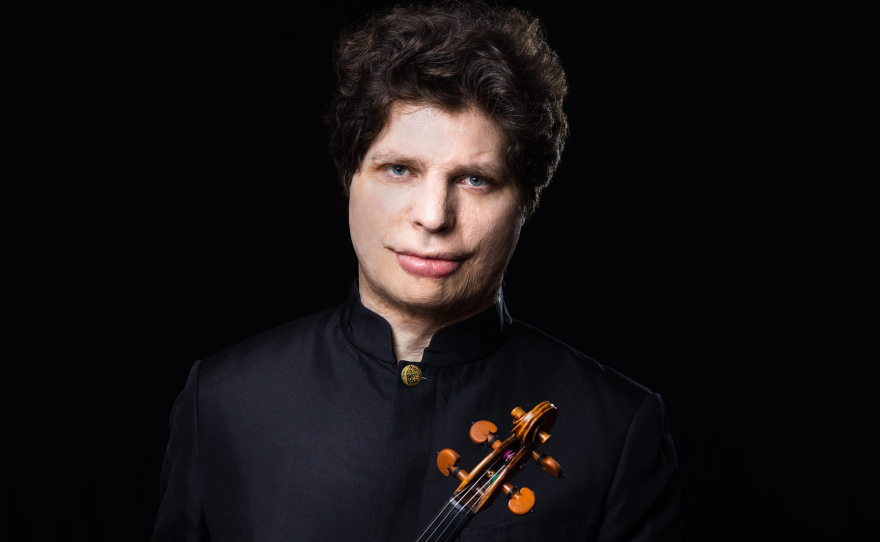
Artists throughout history have responded to nature through their art. The Boston Symphony Orchestra performs Beethoven’s Symphony No. 6, Pastoral, his joyous response to a day spent in the countryside. Before that, 2025-26 BSO Artist-in-Residence Augustin Hadelich performs Thomas Adès’ kaleidoscopic violin concerto Concentric Paths, and the concert opens with Adès' Aquifer. Like his other works, Aquifer depicts the dynamism of the natural world, referencing the static, flowing, and surging properties of water.
Thomas Adès, conductor
Augustin Hadelich, violin
Thomas ADÈS Aquifer
ADÈS Violin Concerto, Concentric Paths, Op. 23
Ludwig van BEETHOVEN Symphony No. 6, Pastoral
This concert is no longer available on demand.
Learn more about the Boston Symphony Orchestra's 2025-2026 season on their site.
In a conversation with CRB's Brian McCreath, Thomas Adès describes his perceptions of conducting two pieces he composed in different times of his life, the difference between writing for a commission and writing out of pure artistic impulse, and what he learns about his own music when others perform and record it.
INTERVIEW TRANSCRIPT (lightly edited for clarity):
Brian McCreath I'm Brian McCreath at Symphony Hall with Thomas Adès, who is back in Boston, fortunately, for some of his own music and a little Beethoven as well. Tom, thank you so much for your time today. I appreciate it.
Thomas Adès Pleasure. Nice to see you, Brian.
Brian McCreath Well, I want to ask you about Aquifer because it's a pretty recent piece. You just wrote it a couple of years ago, I guess, for the Bavarian Radio Symphony Orchestra. And it was on a commission, so I wonder if the way you wrote that piece has to do with the commission, or if it's more of a sort of pure artistic expression of what was in your mind at the time that you wrote it.
Thomas Adès I mean, I think a lot of my purely orchestral pieces, you could have called them "symphony," but I just have a slight aversion to that word because it's so much, instead of anything else, that it tends to imply that they'll do one particular thing rather than a range of possible things that the music might want to do. And this is a sort of one movement symphony, and I've called it Aquifer, in a way, describing what the musical material goes through in order to get from the start to the finish, the musical material being, in this analogy, like water, and the structure that it finds is an aquifer. That's what an aquifer is. It's a structure that water finds in order move from place to place. It literally means "water carrier." So that's the word that I used.
I was invited to write a piece of that scale for orchestra and your thoughts turn to how to do it, you know, how to organize the material. But I don't think it comes across through my pen, as it were, or pencil, any differently because it's written for a particular occasion or orchestra than it does any other way. But there's another respect that, if you look at the symphonies through any composer's life, if there are a number of them, you often find they outline developments and evolutions in that composer's world, whether they're aware of them or not. So, if you held this next to even the other two pieces that I wrote for this conductor, for Simon Rattle, Asyla and Tevot, you can see a progression or a change from one to the other. Funnily enough that you asked this question about whether it's affected by, and if somebody's commissioned it or not, I haven't had an opportunity to find out yet because I've written everything, more or less, everything has been commissioned since I started, more or less, give or take, and just in recent years I've sort of decided to not do that for a bit and just to do whatever came into my head and then say, is there anybody who wants this, to do this? And it is a different experience and it's been enjoyable, you know.
Brian McCreath That's really fascinating and it speaks so highly of the way that people are so attracted to your music that you have basically done commissions this whole time, that people really want to hear your voice. But I'm very interested in your thoughts about creativity when you're not being prompted by anything in particular and you're just following your pure impulses.
Thomas Adès Well, it's as much because it is not wise or advisable to start writing something on the scale of an opera or a ballet without a commission. You're going to open a whole can of worms there, and in for a lot of trouble trying to find anyone to do it. So that's been one of the reasons. But yes, it's just rather surprising because if you don't have a specific person saying we've got this orchestra and that's what we want to do, I might decide that the shape of this new idea wants to be in is an orchestra piece. Or it might turn out to be something else, and I have that complete freedom. So that's quite enjoyable.
Brian McCreath Well, you also anticipated, at least in general terms, you're talking specifically of the symphonic pieces you've written or the symphony-like pieces, but I did want to ask you about the pairing of Aquifer with Concentric Paths, because they are separated by something like 19 or 20 years. And I just wonder if you feel, as you work them with the orchestra, how different they feel to you from their different times.
Thomas Adès They certainly do. Someone said the other day, oh yes, this Violin Concerto is an early work. And I thought, I really don't think of it as an early work. There are definitely some that are to me early works. But then I thought, well, it all depends how long I continue to live. [laughs] I mean, if you give me quite a good run in, I think it could still look like an early work. I hope so. I find that one thing that's noticeable is it requires more rehearsal time, more detailed rehearsal time per minute of the piece than Aquifer because one of the things one does learn is how to make things more efficient for the orchestra. Aquifer is surprisingly, on the whole, not that it's easy to play, it's not, but the assembling of it with an orchestra is relatively straightforward, whereas the Violin Concerto there's more detailed work that tends to need to be done. And that might be a little bit less experience, or you could say that I was really inventing the wheel much more of the way through writing the Violin Concerto than in Aquifer, where I sort of know the terrain a little bit more intimately already. Also, it's a much larger orchestra, Aquifer. That's another thing.
Brian McCreath That's a fascinating insight, though, that your own sense of putting it together is, you're seeing that reflected in the craft of the composition itself, which is really amazing. Have you done Concentric Paths with Augustin before?
Thomas Adès No, I haven't. It's quite a remarkable thing, because he has played it many times and, indeed, made a great recording of it.
Brian McCreath He did, yeah.
Thomas Adès And this is the first time we've done it together, which has been really enjoyable. And I think he was saying to me also today that it all makes sense when I conduct it. Of course, he knows it intimately, and I know it intimately. And so there's very little that we needed to sort of talk about or discuss.
Brian McCreath I wonder at the same time, you wrote the piece for Anthony Marwood, but I wonder, whether it's with Augustin or maybe there's other circumstances like this, what do you learn about your own music when you perform it with somebody new?
Thomas Adès A lot. I mean, Anthony and I go back a long way, you know, he's a good friend, so we worked on it very closely. Then, I think, if I'm right, the next new person I played it with was the Norwegian violinist Peter Herresthal, who's also recorded it. Then there was Pekka Kuusisto, both of whom brought very unexpected insights to it, things I saw, because you see it through someone else's eyes. And then we've had, I'm going to leave someone out, but a great recording by Leila Josefowicz. Another great recording by Christian Tetzlaff has just come out. So, I've been very, very lucky. And all of them bring quite different qualities to the piece. Everyone I've heard play it. Johan Dalene plays it wonderfully. There are very different qualities to it.
Brian McCreath Is there anything specific you can mention about what Augustin does with it that might be different from the others?
Thomas Adès Well, he and I have worked together on a number of occasions, for example, playing the Ligeti Violin Concerto.
Brian McCreath Which you did here.
Thomas Adès Yes, that's right, here. And he has a particularly astonishing technical... I don't know what the word is. It's very hard to describe somebody's whole personality as a player in words, but it's very alert playing and everything he does is so clear and so masterly. And so, I just have to look at him, and I know exactly where the bow is going to move. And he's also a master of surprise, but it's a great pleasure to hear one's music take such clear shape under somebody's hands.
Brian McCreath Well, as you say, it is hard to describe someone's playing in words. I think you actually just did a really nice job of describing Augustin's playing because that applies to so much of what he, well, everything he plays. There's this energy in his playing, this kind of vibrancy in almost every note that he plays. He is an astonishing player. And one of the things about Concentric Paths that I was just observing in rehearsal is that you ask for the soloist to play in this extreme high register. And what kind of came to mind, actually, as I was listening – I don't know quite why this came into my mind – but it came into mind is Ariel's role in [Adès’s opera] The Tempest, and how high that is for a singer. And I just kind of wonder if there's something about extremes of range that attract you sometimes in the music you write.
Thomas Adès Oh, [laughs] I've had occasion to think about this a lot over my life. You see, people keep saying, oh it's extreme. And I think, well, it's just high, but I mean it's all relative. So, if you're a small bird that's just where you sing. That's the normal place. Or if you're Ariel, it's the wind. It's not a she or he or it. It's not a human character, definitely not. It is the wind, and so she lives up there, she lives at this pitch. So, and I also can live up there. Yeah, if it was actually a human soprano singing on the top three notes of the piano, obviously that would be remarkably superhuman, but still, the expression is there. It's a violin, and it's a high of some kind, but I mean, it's still singing to me.
Brian McCreath Tell me about Beethoven Six and why the "Pastoral" Symphony felt like the right thing to put on this program after the two pieces that you programmed by your own good self.
Thomas Adès I can't now reconstruct the conversation that led it to be the "Pastoral." But as so often happens, it does now seem like the only possible one after these two pieces. Of course, Aquifer is, at one level, a description of natural forces, in that case, very much water and how it kind of gurgles and rushes ahead when it finds an aquifer. And then when it's looking for one, it stagnates a bit and it becomes still or it's sort of more turbid or I don't know, whatever the word. The Beethoven is the greatest, I suppose, discovery of the possibility of music to express, as he's at great pains to point out, he says, I'm not painting. It's the expression of feelings arising in the countryside. And this is a little bit like, I think, you have this feeling that he might have been conscious of people who'd say, but Ludwig, you know, you could just paint it. And he's saying, yes, but I'm trying to express the feelings. Of course, it is extremely pictorial as well, especially the "Scene by the Brook." You really can hear every, the rustling of the water and the leaves flickering and the sunlight and it was very visual as well. And then obviously the three birds at the end of that movement. But it's also how these things make him feel. That's very clear. It has this fantastic sense of release and elation to it. It's very much his sort of least troubled, least tortured, certainly, of the symphonies. And then there's the "Storm," which is an extremely violent movement. I mean, there must be a slight element of his many inner demons that are kind of out there. But it's expressed in terms of basically being caught in an appalling thunderstorm and being absolutely drenched and wishing he'd brought a better coat and a better hat and that kind of thing. And the relief of the sun coming out is just a miracle. I suppose the concerto actually has a little bit of that structure as well. The first movement is a sort of whirling introduction to being in a sort of cosmic space, if you like, and whirling around the violin, very high. And that's an introduction. The big movement is the middle movement, the second movement, where all of the various problems and traumas get worked out by the end. And then the last movement is a sort of more released kind of dance. So, there's a slightly similar trajectory in that piece that you then discover in the Beethoven.
Brian McCreath I have this sort of image in my mind that, as the composer, conductor, and everything else you are, that it must be kind of fun when you have your own music placed next to another piece of music, and you begin to hear and see these things that maybe you actually didn't even expect.
Thomas Adès Oh, very much so. And with a classical symphony orchestra especially, the way that the different colors of the orchestra reflect, in this case, natural things - wind, water, movements of nature and the feelings that they evoke - but also, I suppose, the human physical side of it. That's why I still love working with orchestra most of all, because everything is the arms moving up and down of the strings and the lungs of the winds and the wrists of the percussion. It's all very human and physical. I mean, you take the instruments away, of course, this is what you're aware as people feeling these phrases together. And that's the beauty of it. And that immediately links us to...Beethoven can 200 years ago, sounds like a long time. But of course, in the whole course of everything, it's nothing at all. It's a blink of an eye. And he had the same anatomy, literally, and sort of emotionally as the rest of us. So, you find the connections are still physically there. Plus, I like the material that one is working with. I'm working with Aquifer, a piece that ends in C major. It took a certain amount of pushing and pulling to get it to get there, but that's what the piece is about.
Brian McCreath As you just described, that's kind of the whole point of it, is how something gets from one place to another. And C major is just, no better place to land than that.
Thomas Adès Who knows where water's trying to get to? But I'm going to say it's C major.
Brian McCreath [laughs] We'll keep that in mind as we watch the snow melt outside in Boston. So, Thomas Adès, it's so good that you're back. I'm so glad to hear you with this orchestra again. So, thanks for your time today. I appreciate it.
Thomas Adès My pleasure, Brian. Thank you.