


Ahead of "We The People," a week-long festival he curated for the Boston Symphony Orchestra at Tanglewood, legendary cellist Yo-Yo Ma tells WCRB's Brian McCreath about the power of practicing gratitude, music's role in restoring the spirit, and what we can learn from Johannes Brahms.
To hear this conversation, use the audio player above, and read the transcript below:
Brian McCreath: I'm Brian McCreath at Tanglewood with Yo-Yo Ma. And Yo-Yo, thanks for a little of your time today. It's a really busy summer for you, more than usual this year.
Yo-Yo Ma: Brian, it's so great to talk with you. I hear your voice all the time and, you know, it's just nice to see you in person.
McCreath Aw, thank you. Well, it's great to see you in person, and we're going to be seeing a lot of you during "We the People." So I want to ask you about when this was presented to you. Were you asked to do something very specific, or did they just say, "Hey, Yo-Yo, have a week. Do what you want."?
Ma: What you're asking me is above my pay grade. I can't remember anything, but I do remember someone asking me at some point, "Would you do something like that?" And I was so tickled and just thought this was so exciting because I grew up with the Boston Symphony. I grew up in Boston. I grew up almost here in the Berkshires. I've been coming here for 43 years, so my hometown band, right, and the place where my children and grandchildren grew up is— it means so much to me. It's so personal, and the people that live here are such great friends and such wonderful people, and there's such talent and such beauty and appreciation of nature and of history and of all the things, and people with long memories. They're people with such generational memories. And so I feel that "We the People" could be, and should be, and is, right here. And so we're celebrating that. It's our nation for, by the people. And that's what we're doing, the music by the people, for the people. And I hope this is as much of a celebration for the audience that comes as well as for the musicians and other people, storytellers and fiddlers that come and visit, that it's as much of a celebration for them too.
McCreath: I have so many specific questions about the programs you've constructed, but I have to ask first, because I have watched you for so many years and you are so magnetic on stage. You say things to the audience that really kind of put people in such a positive frame of mind. And your themes of, especially the concerts in the Shed, "Gratitude and Friendship," "American Journey," "Looking to the Future Together," these themes are all restorative. You have this way about you that is about restoration. And I sometimes feel like when I leave concerts that you've played at and that you've talked at, I feel better because Dr. Yo-Yo has been here. But what I want to know from you is, what's the diagnosis? What has gone wrong? Why is this so important to us? Where do you see things in the world that need this kind of programming that you've put together?
Ma: Well, I tried to suggest that people take two aspirin and call me in the morning, but that didn't work.
McCreath: It didn't work, did it?
Ma: [Laughing] No. So let's have some music. Actually, music is, in fact, restorative. Music is energy. Sound makes air molecules move. They hit your eardrums, and the vibrations are interpreted by the brain and cause us to get into a particular state of mind with any particular piece of music, right? So that's why radio stations program Baroque music in the morning, light jazz in the evening, and then there's the drivetime music that's sort of zippy and keeps you awake so that when you have too much caffeine and— I mean, it's programmed to do certain things to our states of mind. And I think in this moment, there's a lot about the future and about the present that we don't understand. And usually, when things are not quite right, what do we do? We come to one another and we go to our loved ones to get some form of reinforcement, right? And nature is one of those renewal places, right? You're upset, you go for a walk, you see a tree, you realize the tree is much older than you are and has seen many more things than you have, and somehow you feel a little bit better.
Gratitude is something that... Brooke Thompson-Mills, someone that I've known for years who works with us, she's a wise lady. And I was really upset one year, maybe 20 years ago, and she said, "Have you tried gratitude?" And I was startled. I said, "My goodness, you're right. I should try gratitude, because there's so much to be grateful for." And you know who's taught me so much about gratitude? Native Americans. And during the pandemic, where we were alone, right? We had to be. And I went to Maine to do something with Our Common Nature and met people from the Wabanaki Nation. And Chris Newell, who will be here telling stories and doing a smudge with us, did a sunrise ceremony, which we're going to do here also. And basically, the Wabanakis are all the furthest out people to the east of the United States, right? So what do they do? Their job is to welcome the sun every day. So they start out at the ceremony thanking the sun, thanking the tides, thanking the moon, thanking their ancestors. I played something. There was a wonderful flute player, Hawk, who I think is going to be here also.
So these are my friends from five, six years ago. And they taught me, they opened my life and changed my life to think differently, to think planetary. You know how we're community, country, continent. You think when you get bigger and bigger, you just get more and more abstract. But actually, the way they think about the land and the water and the air is, it's not acquisitive. It is just gratitude for it existing and how it actually helps us. And, you know, I feel better that way. And that's why I've invited so many of my friends to actually be part of this, because not only are they around, but they're actually practicing these very things that help them feel at peace with one another and in the world.
McCreath: And it feels like a big leap, but there's probably something that connects these because somewhere in the thoughts of gratitude and friendship, Brahms entered your mind. Johannes Brahms with these two major pieces. What is it about Brahms's music that speaks to those qualities, those principles that you're getting across in that Friday concert?
Ma: Well, you know, Tony Fogg, who's the artistic administrator, loves to test people on how they play Brahms, because if you can play Brahms well, that actually shows that you're a good musician, because Brahms is a human who sees nirvana, takes you really close to it. He doesn't take you across the threshold. It's hard work. He gets you there. And anybody who's struggled in life and tried really hard and has yearning and is so— wants something to be, and is idealistic, but sees all the impediments along the way and is struggling with them and is not giving up, that's Brahms. And Brahms, at the very end of the Civil War, 1865, he wrote this piece [String Sextet No. 2 in G Major]. And to me, and it was coined by one of the Tanglewood Fellows, she said, "It kind of reminds me of the four seasons of love." And it was written with someone that he was going to get married to [in mind], but decided that he couldn't get married because he needed to stay alone, Agathe von Siebold. And Valeria, wonderful violist, said, "I think of this as four seasons of love, and the four movements actually are from the autumn to winter to spring to summer, all the different forms of love that we can experience throughout our entire life."
And it just spoke to me. And this is, you know, where do you learn things from? You learn things from Wikipedia, you learn things from a Fellow, you learn things from colleagues, you learn things from a casual conversation. And that piece was first performed in Boston.
McCreath: Was it really?
Ma: In 1866.
McCreath: Wow.
Ma: Yeah. We're grateful for Brahms for these incredibly rich and complex thoughts in musical form at a time when sometimes our inner lives are a subsidiary of the outer lives that we're so good at measuring. And Brahms wrote this other piece [Double Concerto in A minor], and part of the gratitude piece [of the program] is to thank the people we need to thank. And one of them, through Renaud Capuçon, the French violinist, my good friend, is to thank France for the help they gave us, without which, if their navy did not arrive in time, the Revolutionary War may have ended up in a different place. And Samy Rachid, our assistant conductor, he's French Moroccan. Morocco happens to be the first kingdom to recognize the United States.
McCreath: I didn't know that.
Ma: Yeah, after the Mi'kmaq Nation recognized the United States two weeks after the signing of the Declaration of Independence, and France was the first nation that had diplomatic relations with the United States. So there are three groups of people that we're grateful for. But Brahms wrote this piece about reconciliation, the Brahms Double Concerto, because he and his best friend [Joseph] Joachim, the great violinist, each chose a different side of a relationship that fell apart. And Brahms was, I think, really craving that friendship. And what do you do to repair a broken friendship? He thought, well, "I should give him a gift. We both love music. How about if I write a piece of music where— for cello and violin— where the cello represents me, Johannes, pleading, trying to remind Joachim, the violinist, of our friendship." And the three movements is the story of that conversation, getting back together in the second moment, and then resuming the friendship. It's clear as day. So you have a love story, and you have a reconciliation, all the things that humans go through.
McCreath: I love it. On Sunday, your "Looking to the Future" program, I think if you asked 50 musicians about a program that would look to the future, you'd get 50 completely different programs. Yours is a really fascinating look at the future because it goes beyond a sort of Western orchestra paradigm. You're bringing in all kinds of other voices and cultures through these three pieces that you've programmed. Tell me, how obvious was it that these were the three pieces you needed on a program that was going to be "Our Future Together?"
Ma: Well, if you ask me how do things happen, I'm not sure of the sequence.
McCreath: Okay, that's fair.
Ma: But I can tell you that my good friend Steven Isserlis, the great British cellist, we were talking and he said, "You should play this piece by Taverner." "Oh," I said, "Okay, tell me about it." He says, "This happened by accident because I was visiting my good friend John Taverner, who was kind of this mystical composer, British and sort of Christian Orthodox. But late in life, he wrote this piece actually for Werner Herzog for film, but it actually incorporated all the religions in it. So here's this Orthodox Christian mystical person who then had a more planetary view of this music." And Steven said, "You've got to play this piece." So I said, "Fine, I'll try and play this piece." And true to form, I thought, this piece actually is a prayer. And it's half improvised. You know, Arooj [Aftab], who's a Pakistani singer, will improvise her part. And Anna Handler, who is the assistant conductor here, it is her last bit, and her parents are coming from Germany.
McCreath: I didn't know that. That's so sweet.
Ma: It's so wonderful. And then she's going to go to LA and do wonderful things with the orchestra there. But she says, "This is kind of like a circular prayer. You're going all the way through." And she had a beautiful way of thinking about it. I thought, this is fantastic. And she spoke with Stephen, and so Taverner is going to be there. It's so beautiful. It's so inner-life-ish.
So then what about the future? Well, who are the people that actually transmit values from generation to generation? Kayhan Kalhor, my great friend from Iran, my sort of spiritual brother, because he plays the kemanché, which is like, I think, great-great-great-great-great-great-great-great-grandfather to the cello. You know, same way, but it's different shape. I love playing with him because it's so spiritual. And he decided to write a piece dedicated to women, all women from all time, women from the past, present, and future. And for him, it's like the people that transmit values, the values of unconditional love, of trust, and of unconditional service. And the role of women cannot be ever overestimated, right? And so there's this piece, and playing with him is not me, but an incredibly talented, wonderful cellist, Karen Ozounian, and she's the future, right?
And as well as the soloist in the next piece. I'm only playing the Taverner, but I want to play in the Taverner because that's the prayer for the future. Christine Lee, the BSO's own Christine Lee, is going to be the cellist in "Azul." And "azul," as you know, is "blue" in Spanish, right?
McCreath: By Golijov.
Ma: Right, by Osvaldo Golijov, who was actually commissioned by the Boston Symphony. Tony Fogg basically almost nurtured the piece into existence. And he's writing another piece for the BSO on The Creation for this fall. And so "Azul," color of the sky, color of the ocean, describing the miracle of life, from its very first appearance of life, from, you know, the primordial soup to the emergence of humans and beyond. And what a better way: to have a prayer, to talk about women, and launch us into the future, and with younger cellists, because these days every cellist is younger. And they are the future.
McCreath: Absolutely. Yo-Yo, thank you so much. This is great. I love hearing you talk about these things. I'm going to love even more hearing them on the stage. Thank you.
Ma: Thank you, Brian. It's all great to see you. And, you know, I should call you Tom Cruise from now on.
McCreath:
[Laughing] I'll keep doing my own stunts.
Ma: Yeah, exactly.
-
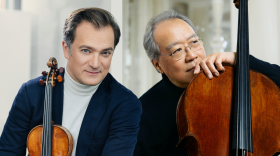 In the first of three BSO concerts curated by Yo-Yo Ma, he and violinist Renaud Capuçon are the soloists in the Double Concerto by Brahms, part of a program led by Samy Rachid.
 -
 In the second of three BSO concerts curated by Yo-Yo Ma, the cellist explores the vibrancy of American music and its reflection of the triumphs, tragedies, and vitality of our country with roots musicians Aoife O'Donovan and Jennifer Kreisberg.
 -
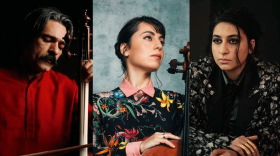 In the final part of a three-concert series curated by Yo-Yo Ma, Grammy-winning vocalist Arooj Aftab joins Ma in John Tavener’s Mahámátar, followed by Kayhan Kalhor’s Venus in the Mirror with the composer and cellist Karen Ouzounian, and Osvaldo Golijov’s Azul with BSO cellist Christine Lee.


